Your employees are already using ChatGPT. What do you do about it?
In almost every organization, employees use AI tools their employer knows nothing about. A ban rarely helps. Here is how to get a grip on it while keeping your team's enthusiasm.
16 September 2026
It is already happening, at your company too
An account manager pastes a customer email into ChatGPT to write a polished reply. A buyer has a free tool summarize a supplier's price list. A project lead drops the meeting notes into an AI app they downloaded themselves. Nobody asked for it, and nobody banned it.
This is called shadow AI, meaning AI use the organization has no view of. How common it is varies by study. A large share of employees use AI for work, and often without their employer knowing. Anyone who thinks it isn't happening in their company usually hasn't asked yet.
Why that is a risk
Company data leaves the building. Free versions of AI tools may use the data you enter to improve their models. Customer data, quotes, margins and HR information end up with a party you have no agreements with.
You don't know what is correct. AI output sounds convincing, even when it is wrong. If a generated text goes to a customer unchecked, you are the one accountable for it.
You are not compliant with the AI Act and the GDPR. The AI Act requires you to know which AI is used in your organization and that your team can handle it. That is impossible when the use is invisible. And personal data in a tool without a data processing agreement is a GDPR problem.
At the same time, shadow AI says something positive. Your people see for themselves where work can go faster, and they are looking for a solution to a real problem. That is exactly the ownership most AI implementations get stuck on. It is something you want to build on.
A ban rarely helps
The first reflex is often a ban. That rarely works. An employee who finds that AI saves them an hour a day won't stop because of an email from management. They will do it on their phone, or at home, and you simply won't see it anymore.
On top of that, you fall behind. The organizations learning to work with AI today are building a lead that is hard to make up later.
How to get a grip on it
1. Just ask. Run a short, anonymous survey. Which tools do you use, what for, and what does it get you? Make it clear nobody will get into trouble, so you get an honest picture of what is going on.
2. Offer a safe alternative. Choose a business environment where your data is not used to train models, with a data processing agreement and preferably with data that stays in Europe. If the official alternative is as easy as the free tool, people will switch on their own.
3. Put what is and isn't allowed on a single page. Which tools are permitted, which data never goes in, and who checks output that goes to customers? Keep it short, so everyone remembers it.
4. Teach your team to work with it. AI literacy is mandatory under the AI Act. A team that knows how to prompt well and assess output also gets more out of it and makes fewer mistakes.
5. Use what you learn. The survey shows where people already save time. Those are your best candidates to tackle structurally, with a solution that works directly with your own systems.
How we solve shadow AI
With a standalone chat tool, your people keep copying and pasting between the AI and systems like the CRM, the ERP and the mailbox. On top of that, whatever a colleague figures out with AI stays in their own chat history. The rest of the team gets nothing from it.
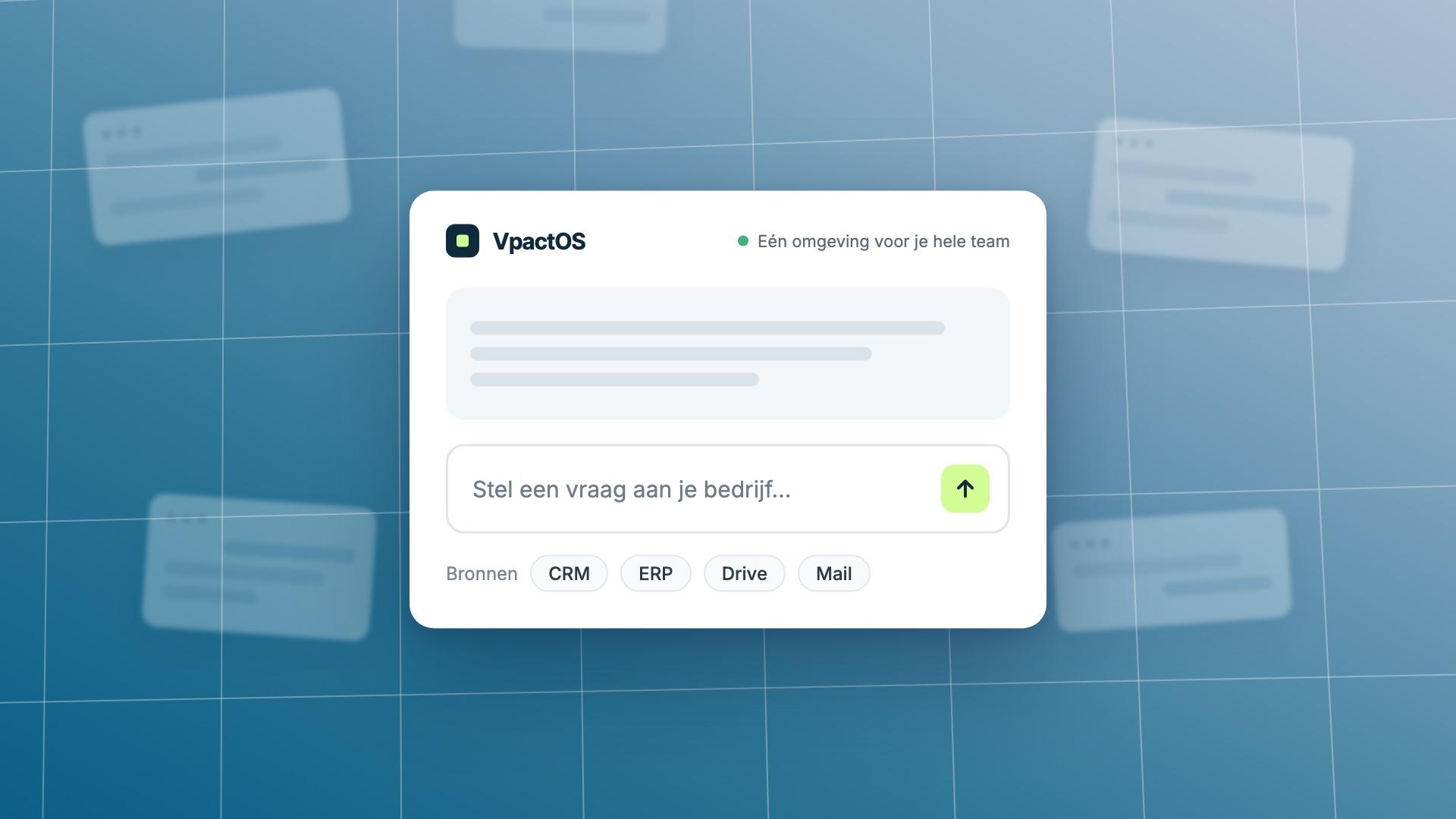
At the organizations we work with, we solve this with VpactOS. It is one secure AI environment for the whole company, connected to the systems you already use. Your team works with it as easily as with ChatGPT. Data stays in Europe, everyone only sees what fits their role, and you know who uses what.
On top of that, your company's knowledge comes together in one place. VpactOS pulls documents, customer data and agreements from your systems, and whatever one colleague figures out is immediately available to the rest. Someone with a question no longer has to call around or click through six systems. And when a colleague leaves, what they knew stays in the organization.
Shadow AI shows that your team is ready. The support you usually have to build first for an AI project is already there.

Become a leader in your industry with AI.
Tell us your challenge.