Is this process ready for AI? Four questions that save you months of work
Most AI projects fail not on the technology, but on the choice of process at the start. These four questions tell you whether a process in your organization is ready for AI.
17 June 2026
Start with the process, not the technology
Most AI projects do not fail on the technology. They fail on the choice made at the very start: which process do we tackle? Choose wrong, and you spend months building something nobody uses or that demands more maintenance than it delivers.
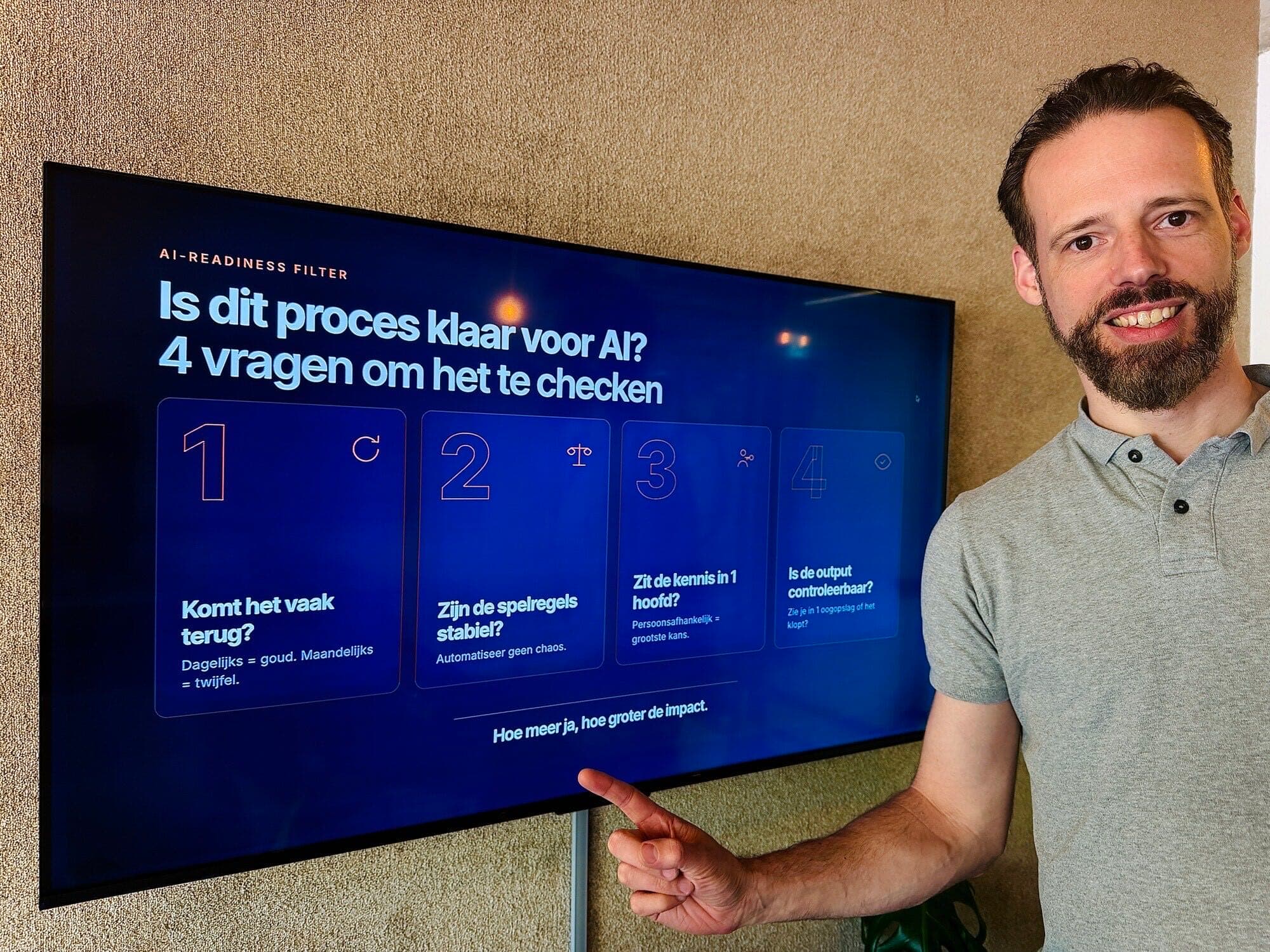
Fortunately, that choice is easy to test. Run a process from your organization past these four questions. The more often the answer is "yes," the greater the chance AI will make a real difference.
1. Does this process recur often?
Frequency determines whether the investment pays for itself. A process that occurs once a month is interesting; once a day is gold. Think of drafting proposals, assessing applications, routing incoming emails, or compiling reports.
One-off exceptions are better solved with a person and a cup of coffee. You do not build a system for those.
2. Are the rules largely stable?
Not perfect, but stable. If the way of working changes every week, you are automating chaos. You would be locking moving agreements into a system that constantly lags behind reality.
Has the process broadly run the same way for years? Then there is a foundation to build on. The details may well change, as long as the core of the work is predictable.
3. Does the knowledge currently sit in one person's head?
Dependence on one person is a red flag for the business, and a green flag for AI. If one colleague is the only one who knows how the assessment works, what the exceptions are, and where the pitfalls lie, you have two problems at once: a continuity risk and a bottleneck.
That is exactly where the value sits. By capturing that process in an AI solution, you cover the risk and make the knowledge scalable. The colleague in question does not become redundant, but the expert who trains the system and keeps handling the tricky cases.
4. Is the output verifiable?
Can you tell at a glance whether the result is correct? A proposal, a match, a summary, a classification: all easy to judge. Someone looks at it, sees whether it is sound, and adjusts where needed.
A decision with legal or financial impact and no review moment is a different story. That is no place for an AI agent without a human in the loop. The rule of thumb: the bigger the consequences of a mistake, the more important the built-in checkpoint.
For every "yes," probe the "yes, but"
That is where the real case lies. "Yes, it recurs often, but the exceptions are tricky." Fine. Then you build for the 80% that is standard, and people handle the 20% that deviates. That is not a compromise; it is exactly how good AI implementations work: the machine does the repetitive work, the human does what requires judgment.
"Yes, the rules are stable, but they are written down nowhere." Also fine. Then the first step is not software, but an afternoon with the people who do the work. That pays off regardless, even if not a single line of code is ever written.
The real result is the conversation
The best effect of this checklist is not the selection itself. It is the conversation it sparks at the leadership table. Suddenly it is no longer about AI as a buzzword, but about which processes truly carry the organization, where the knowledge sits, and where it pinches.
Anyone who works through those four questions seriously ends up not with a wish list of twenty AI ideas, but with two or three processes where automation demonstrably delivers value. And that is a far better start than beginning with the technology and then looking for a problem.

Become a leader in your industry with AI.
Tell us your challenge.